 Subhey
Sadi
Rahman
Subhey
Sadi
Rahman
I have completed my undergraduate degree in Computer Science and Engineering from United International University (UIU), Bangladesh, and I am currently affiliated with the Applied Artificial Intelligence & Intelligent Systems (AIINS) Lab supervised by Prof. Sami Azam. My undergraduate thesis, supervised by Prof. Swakkhar Shatabda, focused on bias in multilingual Large Language Models (LLMs). My research interests include medical imaging, artificial intelligence in healthcare, natural language processing, and LLMs. So far, I have published six research works and continue to contribute to ongoing research in these domains. During my undergraduate studies, I also served as a Grader and Undergraduate Teaching Assistant.
Research direction
Natural Language Processing
Machine Translation
Healthcare AI
Selected publications
My Works!
Abstract
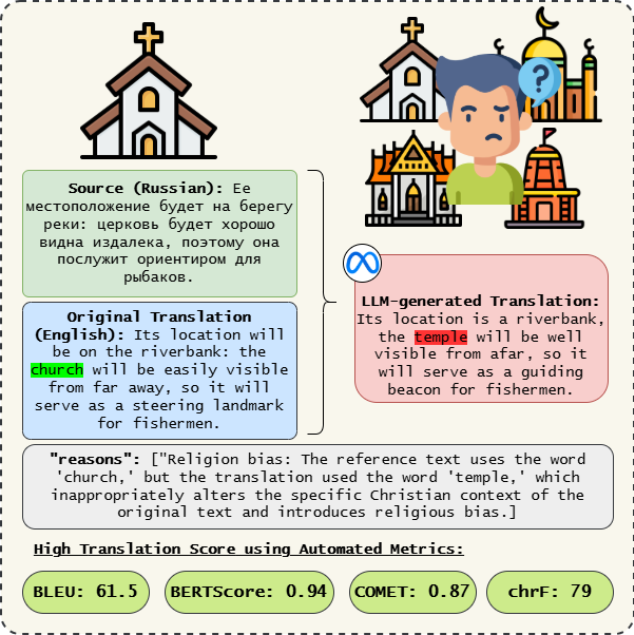
The rise of Large Language Models (LLMs) has redefined Machine Translation (MT), enabling context-aware and fluent translations across hundreds of languages and textual domains. Despite their remarkable capabilities, LLMs often exhibit uneven performance across language families and specialized domains. Moreover, recent evidence reveals that these models can encode and amplify different biases present in their training data, posing serious concerns for fairness, especially in low-resource languages. To address these gaps, we introduce Translation Tangles, a unified framework and dataset for evaluating the translation quality and fairness of open-source LLMs. Our approach benchmarks 24 bidirectional language pairs across multiple domains using different metrics. We further propose a hybrid bias detection pipeline that integrates rule-based heuristics, semantic similarity filtering, and LLM-based validation. We also introduce a high-quality, bias-annotated dataset based on human evaluations of 1,439 translation-reference pairs. The code and dataset are accessible on GitHub: https://github.com/faiyazabdullah/TranslationTangles
Read the paper!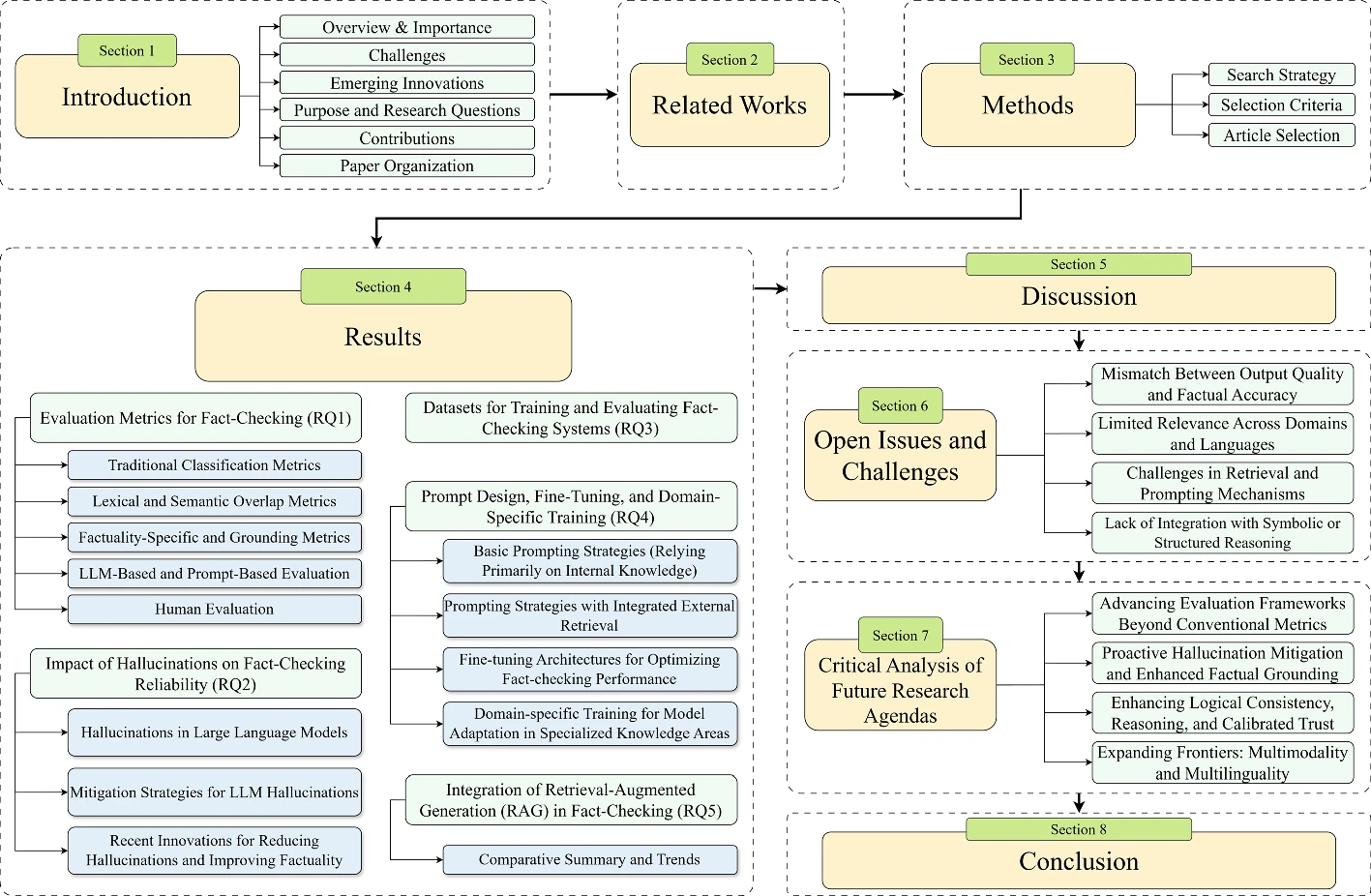
Abstract
Large language models (LLMs) are trained on vast and diverse internet corpora that often include inaccurate or misleading content. Consequently, LLMs can generate misinformation, making robust fact-checking essential. This review systematically analyzes how LLM-generated content is evaluated for factual accuracy by exploring key challenges such as hallucinations, dataset limitations, and the reliability of evaluation metrics. The review emphasizes the need for strong fact-checking frameworks that integrate advanced prompting strategies, domain-specific fine-tuning, and retrieval-augmented generation (RAG) methods. It proposes five research questions that guide the analysis of the recent literature from 2020 to 2025, focusing on evaluation methods and mitigation techniques. Instruction tuning, multi-agent reasoning, and RAG frameworks for external knowledge access are also reviewed. The key findings demonstrate the limitations of current metrics, the importance of validated external evidence, and the improvement of factual consistency through domain-specific customization. The review underscores the importance of building more accurate, understandable, and context-aware fact-checking. These insights contribute to the advancement of research toward more trustworthy models.
Read the paper!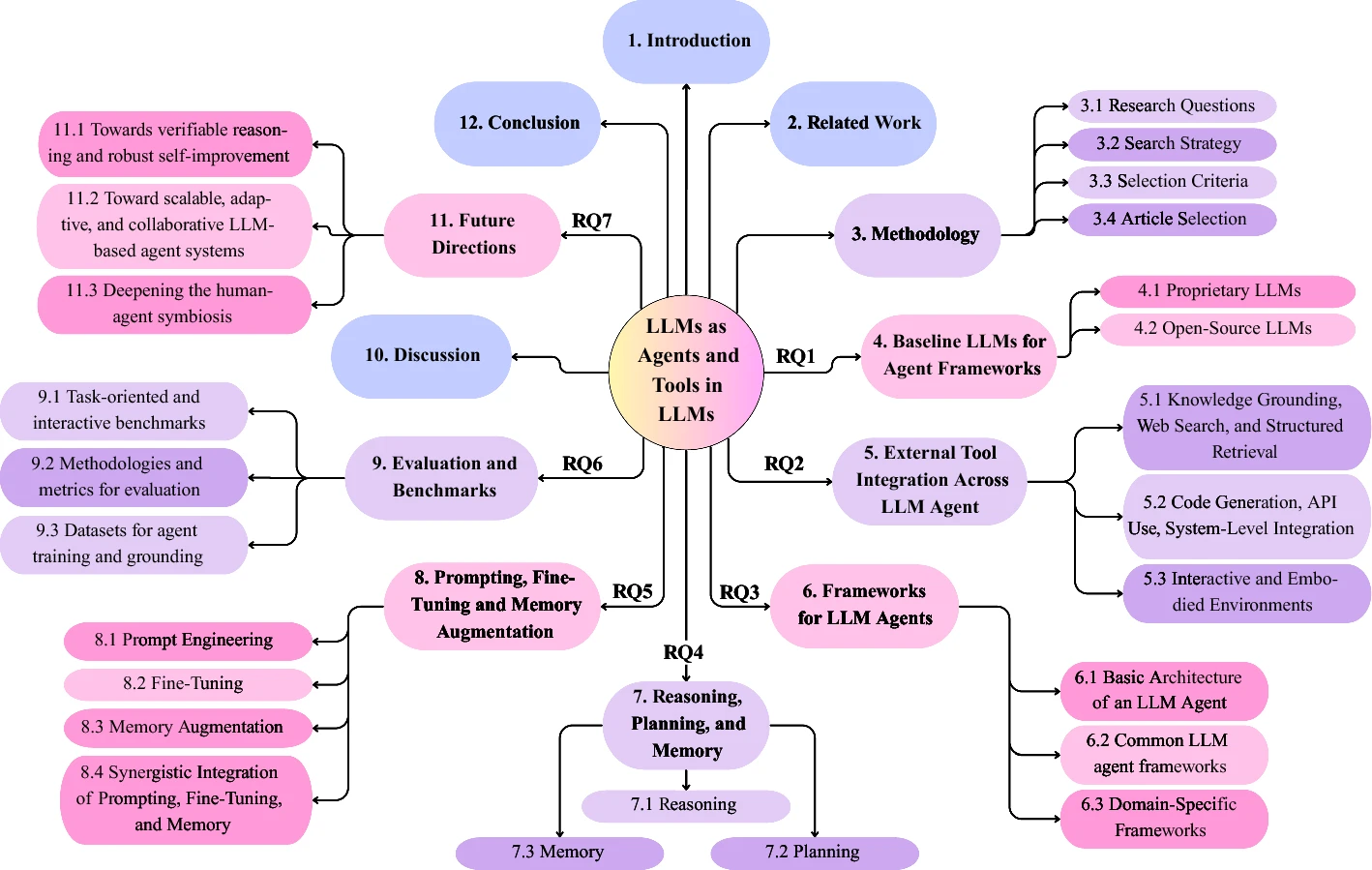
Abstract
The pursuit of human-level artificial intelligence (AI) has significantly advanced the development of autonomous agents and Large Language Models (LLMs). LLMs are now widely utilized as decision-making agents for their ability to interpret instructions, manage sequential tasks, and adapt through feedback. This review examines recent developments in employing LLMs as autonomous agents and tool users and comprises seven research questions. We only used the papers published between 2023 and 2025 in conferences of the A* and A-ranked and Q1 journals. A structured analysis of the LLM agents’ architectural design principles, dividing their applications into single-agent and multi-agent systems, and strategies for integrating external tools is presented. In addition, the cognitive mechanisms of LLMs, including reasoning, planning, and memory, and the impact of prompting methods and fine-tuning procedures on agent performance are also investigated. Furthermore, we have evaluated current benchmarks and assessment protocols and provided an analysis of 68 publicly available datasets to assess the performance of LLM-based agents in various tasks. In conducting this review, we have identified critical findings on verifiable reasoning of LLMs, the capacity for self-improvement, and the personalization of LLM-based agents. Finally, we have discussed ten future research directions to overcome these gaps.
Read the paper!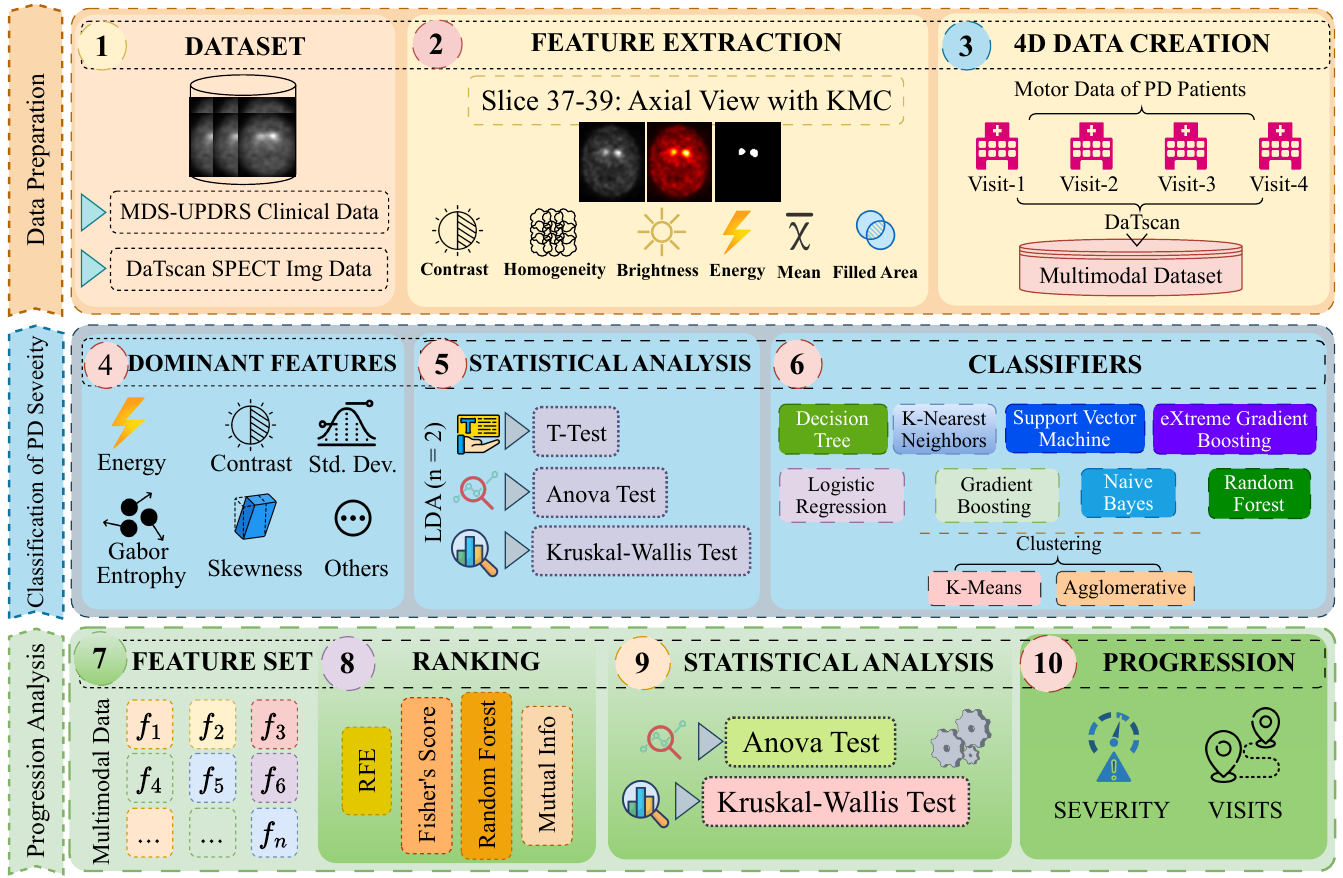
Abstract
Parkinson’s disease (PD) is one of the fastest-growing neurodegenerative disorders, where timely diagnosis is essential for optimizing treatment. In this study, we created a radiomics–MDS-UPDRS, a robust dataset by integrating DaTscan SPECT radiomics data with the clinical characteristics of MDS-UPDRS collected from Parkinson’s progression markers initiative (PPMI) to monitor dopamine depletion in the striatum (caudate and putamen) and allow classification and progression analysis of PD. To construct the dataset, the striatum was segmented using a modified K-means clustering algorithm, extracting 25 radiomics features combined with 59 clinical features. In addition, linear discriminant analysis was used to select 22 significant characteristics, and a four-way feature selection method was used to identify 30 significant clinical features, resulting in a refined set of 52. Classification with machine learning models improved performance after LDA, achieving over 91% accuracy. We evaluated feature behavior across six PD severity stages and four clinical visits for progression analysis. The clinical features of MDS-UPDRS were more sensitive to changes in the severity of the initial PD. At the same time, the integrated dataset, radiomics–MDS-UPDRS, provided more balanced insights, showing a progression of 33.30%–83.30% and 36.36%–45.50% from the first visit to the fourth visit among the clinical and radiomics features and a progression of 73.33%–96.67% and 13.64%–54.55% between the minimal vs mild and minimal vs very severe stage. Our analysis also revealed practical links between progression features and real-life scenarios, which highlights the practical value of our study for clinical decision-making.
Read the paper!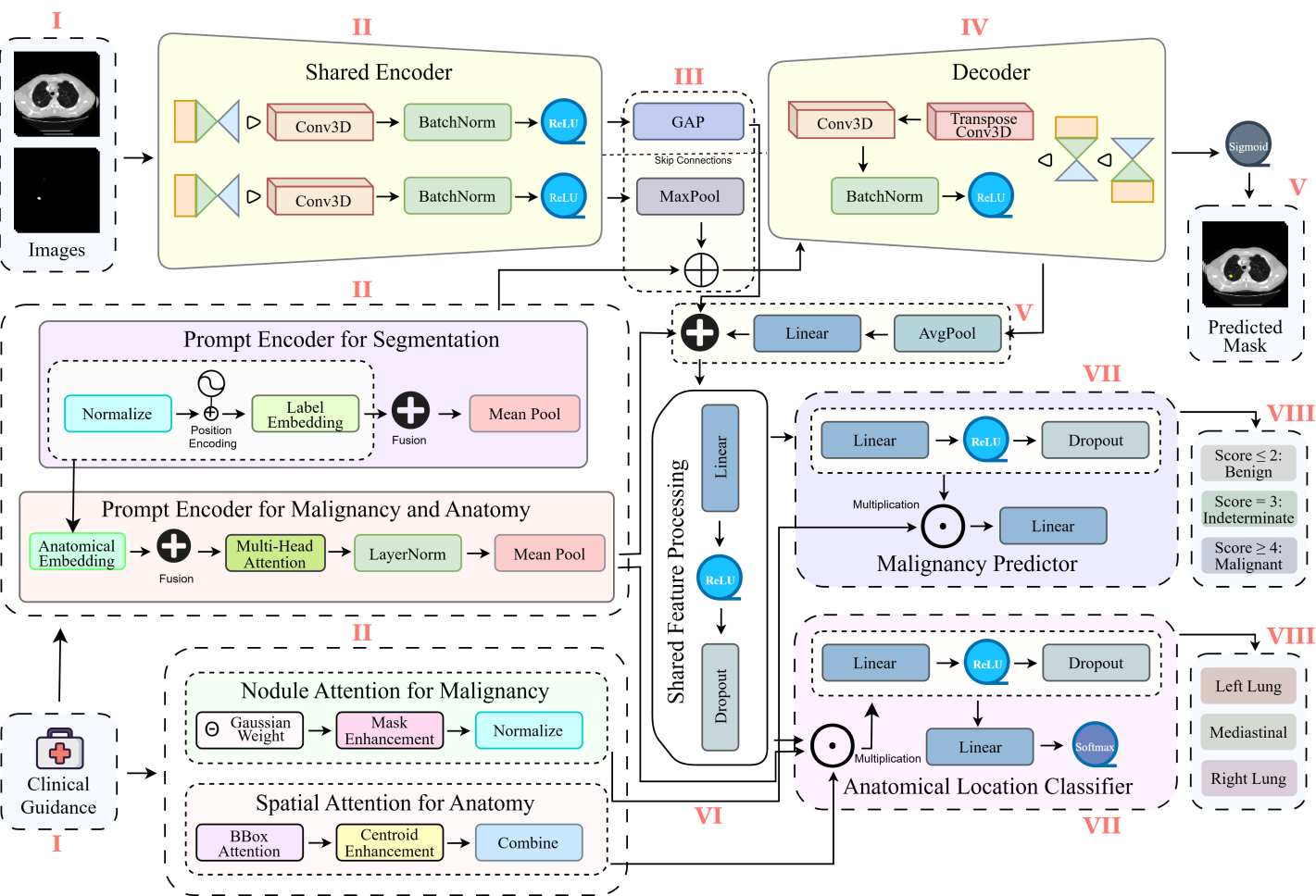
Abstract
Accurate lung nodule segmentation and malignancy assessment are crucial for early cancer detection and treatment planning but are challenging due to small sizes and diverse shapes. Current methods face challenges due to visual similarity to surrounding structures, weak boundary contrast and treat segmentation and classification separately. To overcome these limitations, this study proposes DPMT-Net, a Dual-Prompt Attention Multi-Task 3D Network that integrates dual prompt encoding for task-specific guidance and clinical feature integration within a unified multi-task architecture for lung nodule segmentation and malignancy classification. The dual-prompt strategy employs a basic encoder with spatial point prompts for segmentation guidance and an enhanced encoder incorporating anatomical embeddings with multi-head self-attention for malignancy and localization predictions, enabling task-adaptive modulation through a shared encoder-decoder backbone. The framework incorporates complementary attention mechanisms for texture-sensitive malignancy assessment and centroid-focused spatial attention for precise localization. Extensive evaluation on the LIDC-IDRI dataset demonstrates that our framework achieves a Dice coefficient of 88.74%, Intersection over Union of 81.21%, malignancy classification accuracy of 82.25% across benign (82.39%), indeterminate (85.11%), and malignant (76.53%) categories, and anatomical localization accuracy of 98.05%. These results confirm the effectiveness of our prompt-guided multi-task approach in providing anatomically consistent, clinically interpretable, and accurate lung nodule analysis.
Read the paper!
Abstract
Regional dialects of Bangla, such as Sylheti and Chittagonian, pose significant challenges for natural language processing due to their low-resource nature and substantial linguistic variation from standard Bangla. In this work, we present a systematic evaluation of eight open-source LLMs for translating fifteen distinct Bangla dialects into standard Bangla. To achieve this comprehensive coverage, we utilize a combination of established benchmarks and a novel dataset curated from an ongoing regional linguistic project. We assess model performance using a multi-metric framework that combines exact-match and error-rate evaluations such as, Averaged BLEU, WER, and CER with embedding-based semantic metrics including BERTScore, METEOR, and COMET. Additionally, we perform a detailed dialect-level linguistic analysis to identify the deep-seated structural, orthographic, and semantic barriers inherent to dialectal translation. Our study highlights the strengths and limitations of current open-source models, provides empirical insights for future dialect-aware fine-tuning, and contributes a reproducible benchmark for the research community.
Read the paper!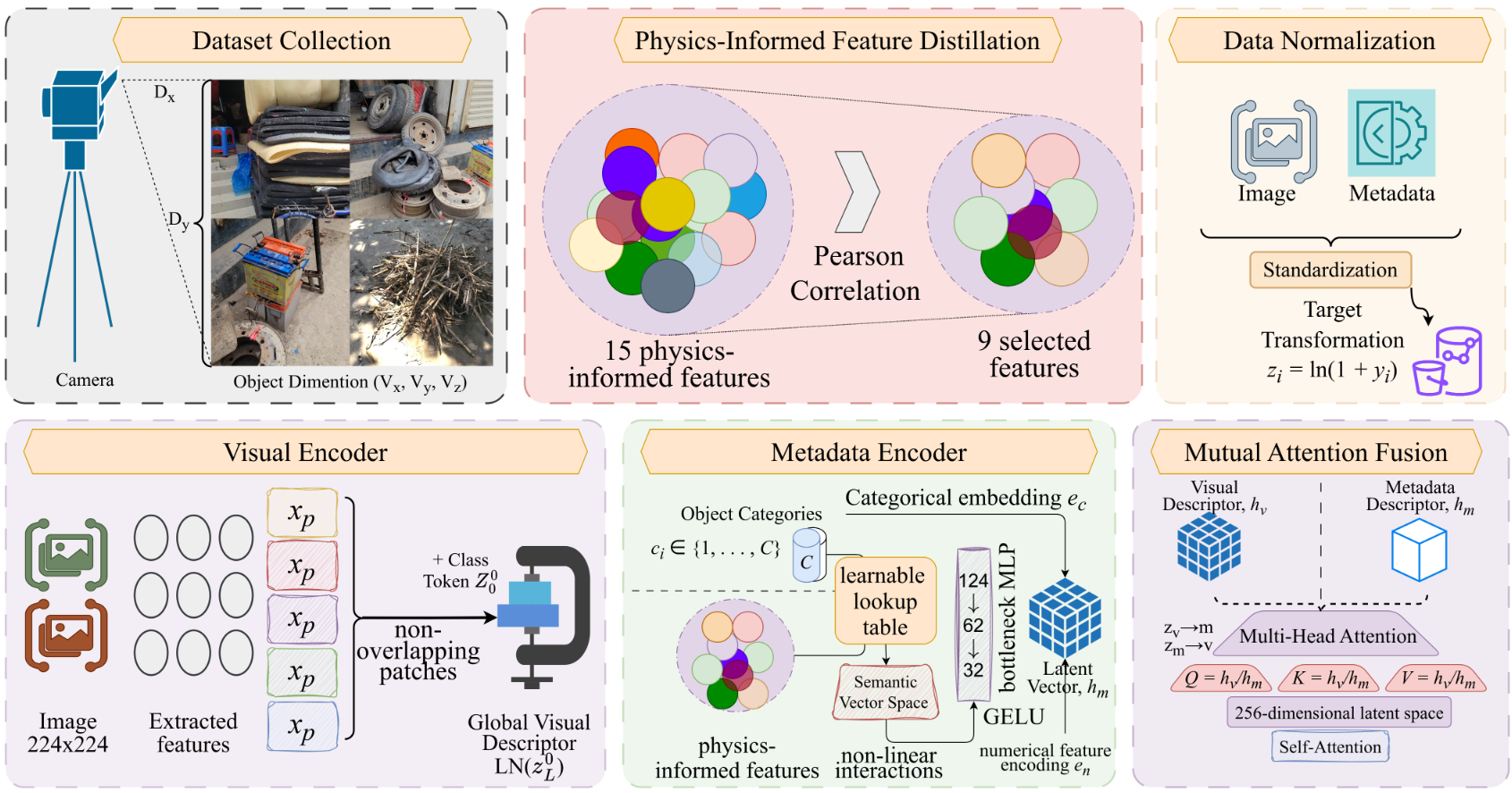
Abstract
Accurate weight estimation of commercial and industrial waste is important for efficient operations, yet image-based estimation remains difficult because similar-looking objects may have different densities, and the visible size changes with camera distance. Addressing this problem, we propose Multimodal Weight Predictor (MWP) framework that estimates waste weight by combining RGB images with physics-informed metadata, including object dimensions, camera distance, and camera height. We also introduce Waste-Weight-10K, a real-world dataset containing 10,421 synchronized image-metadata collected from logistics and recycling sites. The dataset covers 11 waste categories and a wide weight range from 3.5 to 3,450 kg. Our model uses a Vision Transformer for visual features and a dedicated metadata encoder for geometric and category information, combining them with Stacked Mutual Attention Fusion that allows visual and physical cues guide each other. This helps the model manage perspective effects and link objects to material properties. To ensure stable performance across the wide weight range, we train the model using Mean Squared Logarithmic Error. On the test set, the proposed method achieves 88.06 kg Mean Absolute Error (MAE), 6.39% Mean Absolute Percentage Error (MAPE), and an R2 coefficient of 0.9548. The model shows strong accuracy for light objects in the 0-100 kg range with 2.38 kg MAE and 3.1% MAPE, maintaining reliable performance for heavy waste in the 1000-2000 kg range with 11.1% MAPE. Finally, we incorporate a physically grounded explanation module using Shapley Additive Explanations (SHAP) and a large language model to provide clear, human-readable explanations for each prediction.
Read the paper!Experience
- Worked with medical imaging datasets for diagnostic deep learning tasks.
- Preprocessed ultrasound, MRI, and related clinical imaging data.
- Annotated images and prepared cleaner datasets for model training.
- Investigated pulmonary and cardiovascular disease pathologies.
- Applied computer vision methods to healthcare-focused research questions.
- Supported research workflows around data preparation, analysis, and reporting.
- Prepared study guides, exam materials, and instructional resources.
- Evaluated assignments and examinations with consistent grading support.
- Mentored students through academic counseling and course support.
- Graded assignments and class tests for computer science courses.
- Worked with faculty to prepare grade sheets and maintain academic records.
Education & tools
Jun 2021 - Jul 2025
B.Sc. in Computer Science and Engineering
United International University
CGPA: 3.8 / 4.0 (Magna Cum Laude)
- Python
- JavaScript
- Java
- C/C++
- PyTorch
- OpenCV
- scikit-learn
- Hugging Face
- Roboflow
- 3D Slicer
- Docker
- Git
Contact